Medway Developer Contributions and Obligations Guide
2.1 Background
2.1.1 Medway is a unitary authority in the historic county of Kent with a population of around 292,000. The planning process can support the delivery of development to meet the area’s needs for homes, jobs, services and infrastructure. The delivery of timely and appropriate investments in infrastructure improvements to support housing growth is a major issue. It is the key concern raised by residents in consultation on the new Medway Local Plan, and a common issue for comments on planning applications. View representations
2.1.2 The One Medway Council Plan sets out the council’s vision, ambitions and priorities up to 2028 as well as the corporate values and behaviours. The new Local Plan reflects these ambitions. View representations
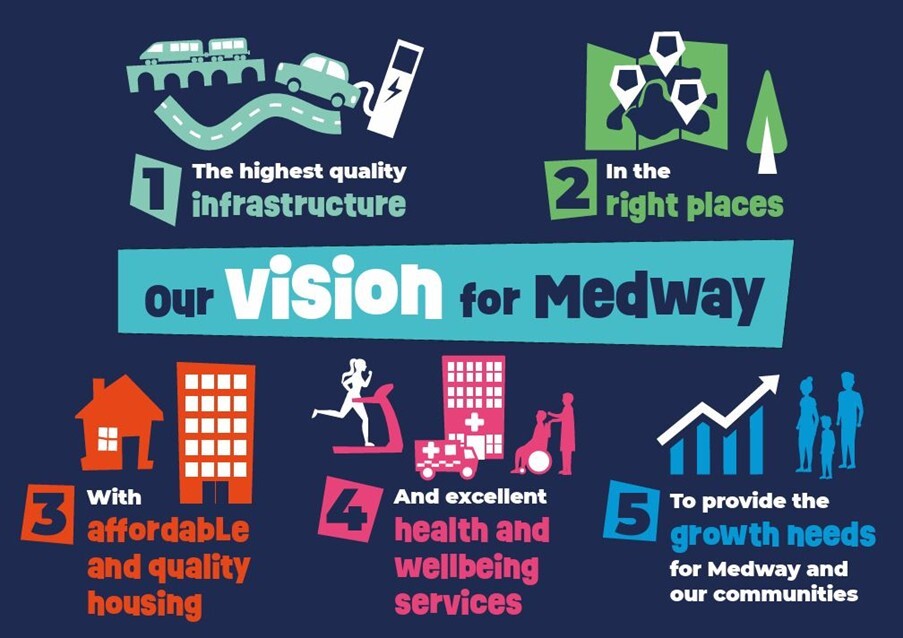
2.1.3 The council wants to ensure that the process of securing the delivery of upgraded infrastructure and services to meet the increased demands arising from new development works effectively. This guide is a supplementary planning document and is a material consideration in determining planning applications.
2.1.4 This guide has been prepared in accordance with planning legislation and policy overseeing the processes of securing appropriate contributions and obligations from developments. Planning obligations or agreements and Unilateral Undertakings are normally entered into in accordance with Section 106 of the Town & Country Planning Act 1990 (as amended). These tend to be referred to on a day-to-day basis as ‘Section 106 (S106) agreements’ and this term is used throughout this guide. View representations
2.1.5 Section 106 of the 1990 Act provides that anyone with an interest in land may enter into a planning obligation, which is enforceable by a Local Planning Authority. An obligation may be created by agreement or by the party with an interest in the land making a unilateral undertaking. Obligations may:
- Restrict the development or use of land
- Require operations to be carried out in, on, under or over the land
- Require the land to be used in any specified way; or
- Require payments to be made to the Local Planning Authority, either in a single sum or periodically.
2.1.6 Obligations run with the land and, providing all parties with an interest in the land enter into the agreement, affect everyone with an interest in it, including successors in title. They are registered as Local Land Charges.
2.1.7 The main principles governing the use of obligations are that:
- They should only be used when planning conditions are not appropriate
- They are intended to make development acceptable which would otherwise be unacceptable in planning terms
- They can be used to prescribe the nature of the development (e.g. a proportion of the housing must be affordable), to compensate for loss or damage caused by the development (e.g. loss of open space) or mitigate a development’s impact (e.g. increase public transport provision).
2.1.8 All S106 agreements should satisfy the following tests:
- it must be necessary to make the proposed development acceptable in planning terms,
- it is directly related to the proposed development,
- it is fairly and reasonably related in scale and kind to the proposed development.
2.1.9 Agreements must be governed by the fundamental principle that planning permissions may not be bought or sold, and they cannot be used to secure a share in the profit from development.
2.1.10 Contributions may be either in kind or in the form of a financial contribution. Payments can be made in the form of a lump sum, an endowment, or as phased payments related to dates, events or triggers.
2.1.11 Local Planning Authorities should set out their policy on local standards, including infrastructure contributions and requirements for affordable housing in the Local Plan. The plan is subject to testing the cumulative impact of policies and requirements on viability, so that the Local Plan can be delivered.
2.1.12 Medway Council supports the delivery of quality development which delivers its ambitions for the area’s successful growth. The council has led in the production of a Planning Protocol for Delivering Growth in Kent and Medway. This aims to provide increased efficiency and certainty in the planning process for communities and developers. The protocol sets out the council’s commitment to effective communication and working to increase certainty and consistency in the development planning process. The preparation and review of this Guide to Developer Contributions and Obligations specifically addresses the standards and commitments set out in the Planning Protocol.
2.1.13 This Guide provides clarity to developers and wider stakeholders on the requirements for infrastructure arising from consented developments, and associated obligations to ensure that the impacts of new developments are appropriately considered and mitigated.
2.1.14 The Council’s policy in respect of developer contributions is set out in Policy S24 of the Submission Medway Local Plan 2041. This states that:
“Development coming forward in Medway will be expected to deliver new or improved infrastructure, to mitigate the impact of development. This will be achieved through the use of planning obligations and/or contributions and their use as defined in national policy and guidance, and as set out in the latest Medway Guide to Developer Contributions and Obligations. Infrastructure includes requirements having regard to the details set out in the latest IDP, as well as studies on leisure, green infrastructure, neighbourhood plans and development orders and other needs assessments.”
2.1.15 This policy updates the current policy from the 2003 Medway Local Plan, and is to be the basis for the detailed requirements set out later in this guide. Further detail is also set out in site specific strategic allocation policies in the new Local Plan.
