Medway Developer Contributions and Obligations Guide
14.1 Background
14.1.1 Social care covers a wide range of services provided to the most vulnerable people in the community. It includes Social Work teams, Occupational Therapists, who support older people, adults with physical disabilities, adults with learning disabilities, adults with mental ill health and their carers. However, there are significant challenges facing Medway Adult Social Care and the choice that it can offer its residents, similar to other local authorities across the UK. Costs are steadily increasing, and this is particularly true of the residential care home sector, particularly those supporting people with complex dementia.
14.1.2 Under the Care Act 2014, individuals have the legal right to make choices about their care and support. The Act places a duty on local authorities to ensure that people are at the centre of decisions affecting their lives, including being offered a range of high-quality care options that reflect their personal preferences and needs. It promotes person-centred care planning, where individuals can shape their own support arrangements, including through personal budgets. This empowers people to choose services that best suit their circumstances, fostering independence, dignity, and well-being.
14.2 Policy context
14.2.1 In year 2023/2024, Medway’s total gross spend on Adult Social Care was £139.5million, up from £124.8million in 2022/2023. At end of Quarter 1 2024/2025, the figure was forecast at £145million.
14.2.2 Residential and nursing care costs account for a large proportion of total expenditure. The total gross spend across Residential and Nursing for all Adult Social Care client groups for 2022/23 was £46.9million. It rose to £52.9million in 2023/24, representing 38% of total Adult Social Care spend.
14.2.3 Adult Social Care received 14,864 requests for support from clients in 2024-25. In this period, 6.8% of the completed requests had an outcome of new long-term community, residential or nursing care. 60.4% of the new requests came from those aged 65 and over, which is a further reduction on the 67.1% in 2023-24.
14.2.4 In the Medway Joint Strategic Needs Assessment for Adults, it projects that the percentage of residents aged over 65 will increase by 24% by 2040, representing an additional 11,400 people. However, the number of adults aged 18-64 is set to see an increase of only 1% in the same period. The largest increases are predicted in the older age cohorts, with a particularly large increase of 55% in those aged 85+, representing an extra 3,100 people.
14.2.5 An ageing population is likely to see increases in conditions such as dementia. There is a predicted 38% increase in the number of older people within dementia between 2023 and 2040. Other projections indicate a greater potential increase, with a rise by 46% over a shorter time period between 2019 and 2030.
14.3 Requirements
14.3.1 Medway Council is facing a shortage of care home provision, and new care home placements, which has led to an increase in the average bed cost. In addition, the Council is having to commission placements in Care Homes that are not rated as good or outstanding.
14.3.2 Since 2020 we have observed an increase in planning applications for new care home developments. Although capacity is slowly growing, it is not growing at the pace to meet future demand or that creates a competitive market.
14.3.3 There is a growing demand for a specialised care home in Medway that can meet the needs of residents living with dementia in a residential and nursing facility. It is estimated nationally that around 70% of care home residents are living with some form of dementia. Of Medway’s total ASC clients, 10% had dementia as a primary care need as of March 2024; 96% of those were over 65.
14.3.4 The lack of capacity within Medway means a proportion of our residential and nursing dementia clients live in care homes outside of Medway. Not only does this increase the weekly cost; it places pressure on family and carers who need to travel further to visit. In March 2024, this represented 11.4% of our residential and nursing care clients (all ages), a slight but sustained increase from 9.3% in April 2021.
14.4 Current landscape
14.4.1 In April 2024 there were 70 care homes in Medway. 16 care homes include nursing provision, and the remaining 54 are without nursing. In terms of beds provided, there were 809 beds in care homes with nursing (note: not all of these will be nursing beds), and 876 beds in care homes without nursing. This is a total of 1,685 beds in Medway in April 2024 - the equivalent of 778.04 beds per 10,000 people aged 75 and over (see Table 1 below). It is important to note that these are the number of beds in Medway and not the number of contracted beds the council has with care homes.
|
Area |
|||||||
|
Apr 2024 |
|||||||
|
England |
|||||||
|
Medway |
|||||||
|
Mean for Southeast (ADASS Region) |
76.8 |
72.6 |
71.4 |
70.8 |
78.9 |
75.0 |
58.0 |
14.4.2 The combination of lack of both capacity and high-quality provision in the table below (Table 9) illustrates Medway’s current challenge.
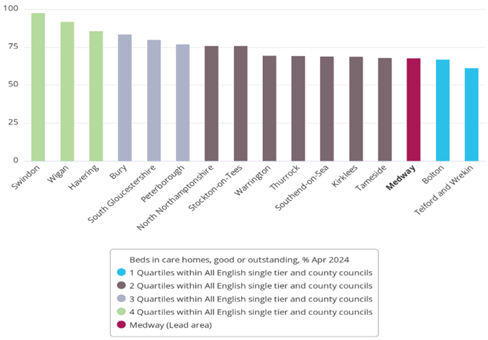
14.4.3 The current lack of capacity does not provide the service to which we aspire for our residents, and the Council is not meeting its duties detailed in section Service data indicates a rising prevalence of dementia in care home users, and the number of people with dementia in Medway is predicted to rise by 46% between 2019 and 2030.
14.5 Where it applies?
14.5.1 All developments of 10 or more dwellings.
14.6 Summary
14.6.1 A contribution towards purpose-built facilities to meet the needs of the increased, ageing population in Medway, i.e. the redevelopment of units such as Nursing care homes and accommodation suited to care for people living with Dementia.
